Instruments
What are you reviewing?
Find what you are holding. Each line names the instrument that reviews it and the essay to read first.
-
A care management savings claim, yours or a vendor's
InstrumentCare Management
Read firstDoes the Care Management Savings Claim Survive a Comparison Group?
-
A prior authorization list
InstrumentPA Portfolio · Auth Variation
Read firstA Prior Authorization List Should Be Audited by Someone Who Isn't Defending It
-
A cost-of-care savings number
InstrumentCost of Care
Read firstMost Cost-of-Care Savings Numbers Are Produced by Hand, Once — and Then Argued About Forever
-
Personal care hours under a waiver
InstrumentPAS Hours
Read firstThe Question Under Every Personal Care Hours Fight: What Is the Waiver Actually Buying?
-
Private duty nursing hours for a child
InstrumentPDN Hours
Read firstPrivate Duty Nursing Disputes Are Won and Lost on One Word: Continuous
Its hours are model hours, pending clinical review.
-
A pharmacy benefit manager's claimed savings
InstrumentPharmacy
Read firstYou Cannot Audit Your Own Drug Costs. Congress Just Admitted It.
-
A payment integrity program's reported recoveries
InstrumentPayment Integrity
-
A plan P&L and the levers in it
InstrumentP&L Simulator
Read firstThe Levers Move Less Than the Weather. That Is the Whole Finding.
Its ranges are scenario envelopes, not established uncertainty intervals.
-
A department you have been handed
InstrumentUnit Assessment
Read firstBefore You Fix Your Department, Find Out What You're Actually Running
-
A quality leader’s year: what to fund, book, sign, challenge and report, and when
InstrumentQuality Revenue · Stars Ops · Gap Economics
Read firstThe quality leader’s year
-
A care leader’s year: the list, the clocks, the criteria, the programs and the savings to book
InstrumentPA Portfolio · Auth Variation · Clinical Validators · Care Management · Care Models · Pharmacy · PAS Hours · PDN Hours · High Claimants · Cost of Care
Read firstThe care leader’s year
To use an instrument, ask for access: write to the address on Contact and name the instrument and what you are reviewing.
The instruments
Access is by invitation. Sign-in refuses any account that has not been added.
Every instrument
Every instrument in the suite, the area it sits in, and its essay where one has been written. The practice is at research stage: the instruments are research prototypes, and the engagement they would serve is a proposed format.
- 29instruments
- 27with an essay here
From the essay on the practice:
1. Tool, learning, authority — every instrument has all three layers. The tool computes. The learning layer teaches the method to someone new to the field, because a client who can't understand the analysis can't defend it after we leave. And the authority layer is the one that matters most: every threshold, benchmark, and legal claim resolves to a declared source — a regulation, a case, a published study — and the build literally fails if a citation stops resolving.
3. Honesty is enforced, not promised. Every source that no person has re-read is counted and displayed — today the counter is public inside the suite and it isn't flattering. Unverified is a state we show, not a state we hide. Same for measurement: our care management instrument's first job is to tell you whether a savings number could be true, including ours.
What the instruments look like
Four of them, with nothing entered. No client data is on any screen.
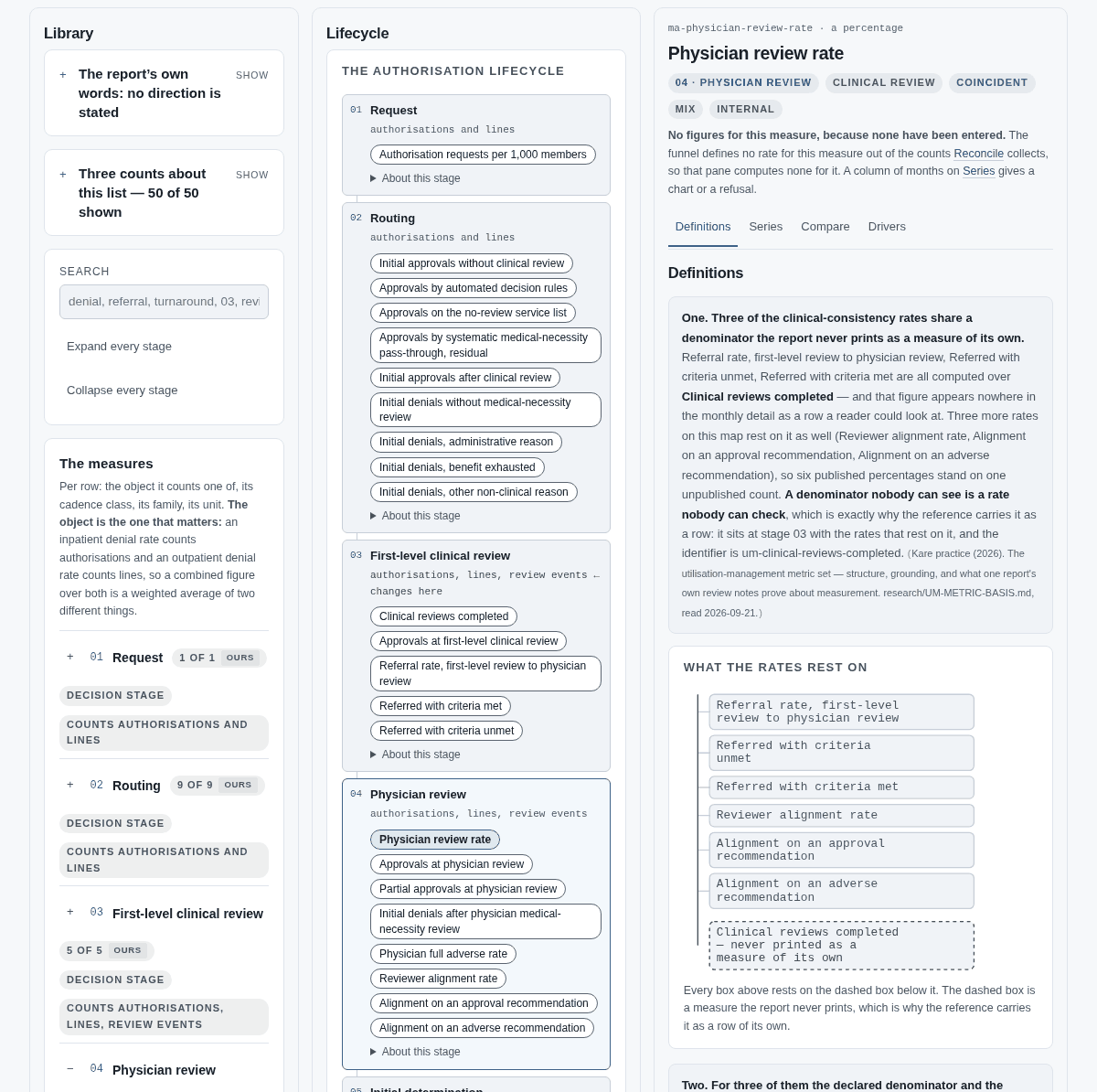
Auth Variation — the workspace, with one lifecycle measure selected. 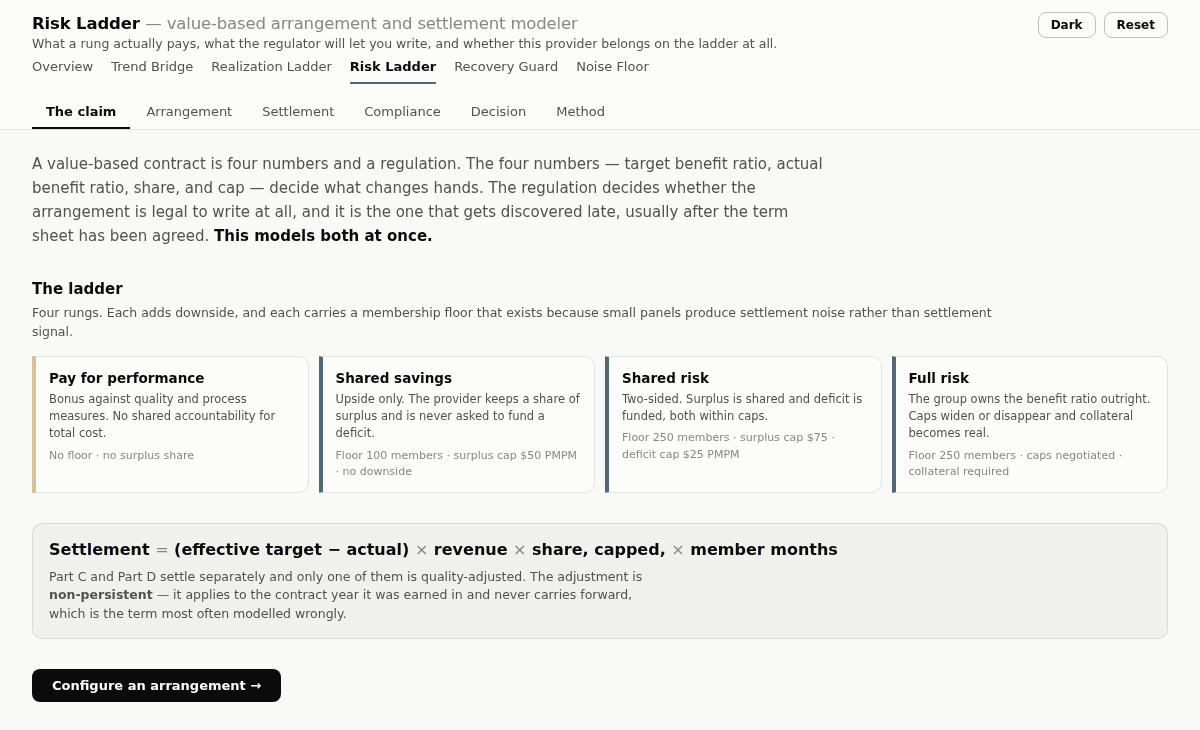
Cost of Care — the risk ladder, its four rungs and the settlement formula. 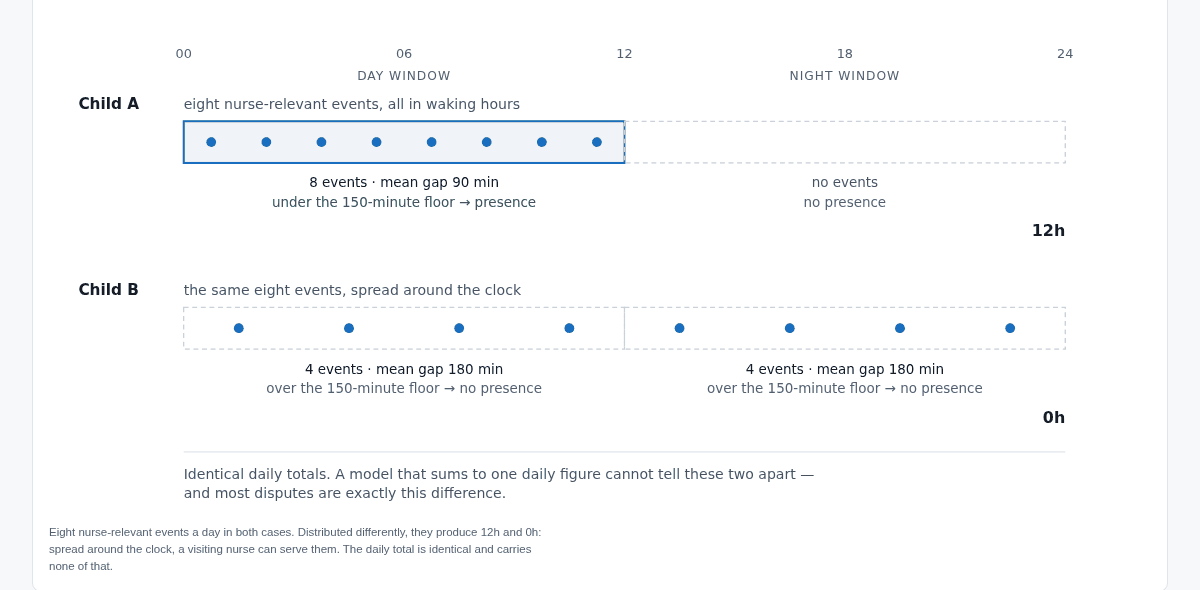
PDN Hours — the two-windows figure from the page that explains the test. 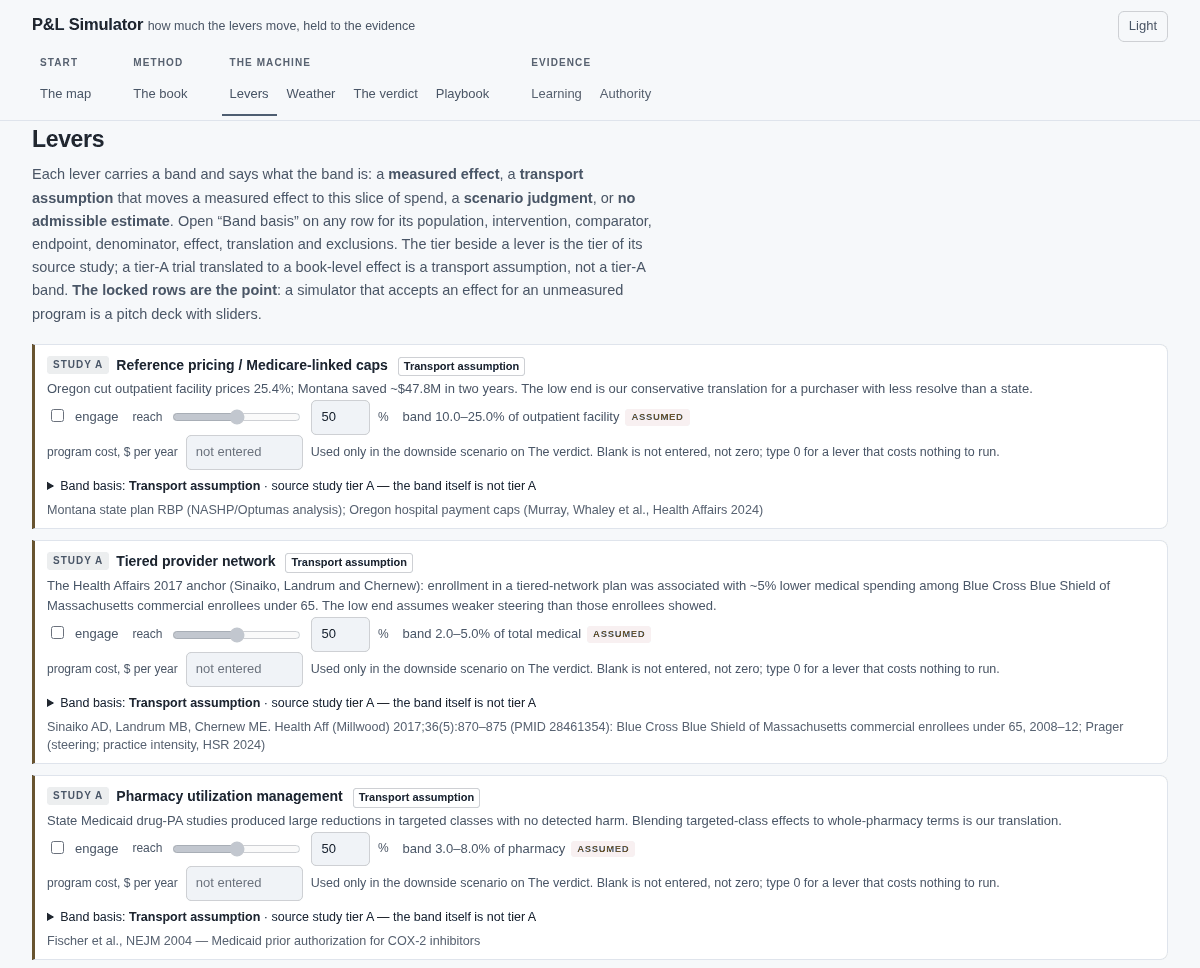
P&L Simulator — the levers, each with the band its evidence supports.